Bootbase — Translating Personal Style into Structured Data
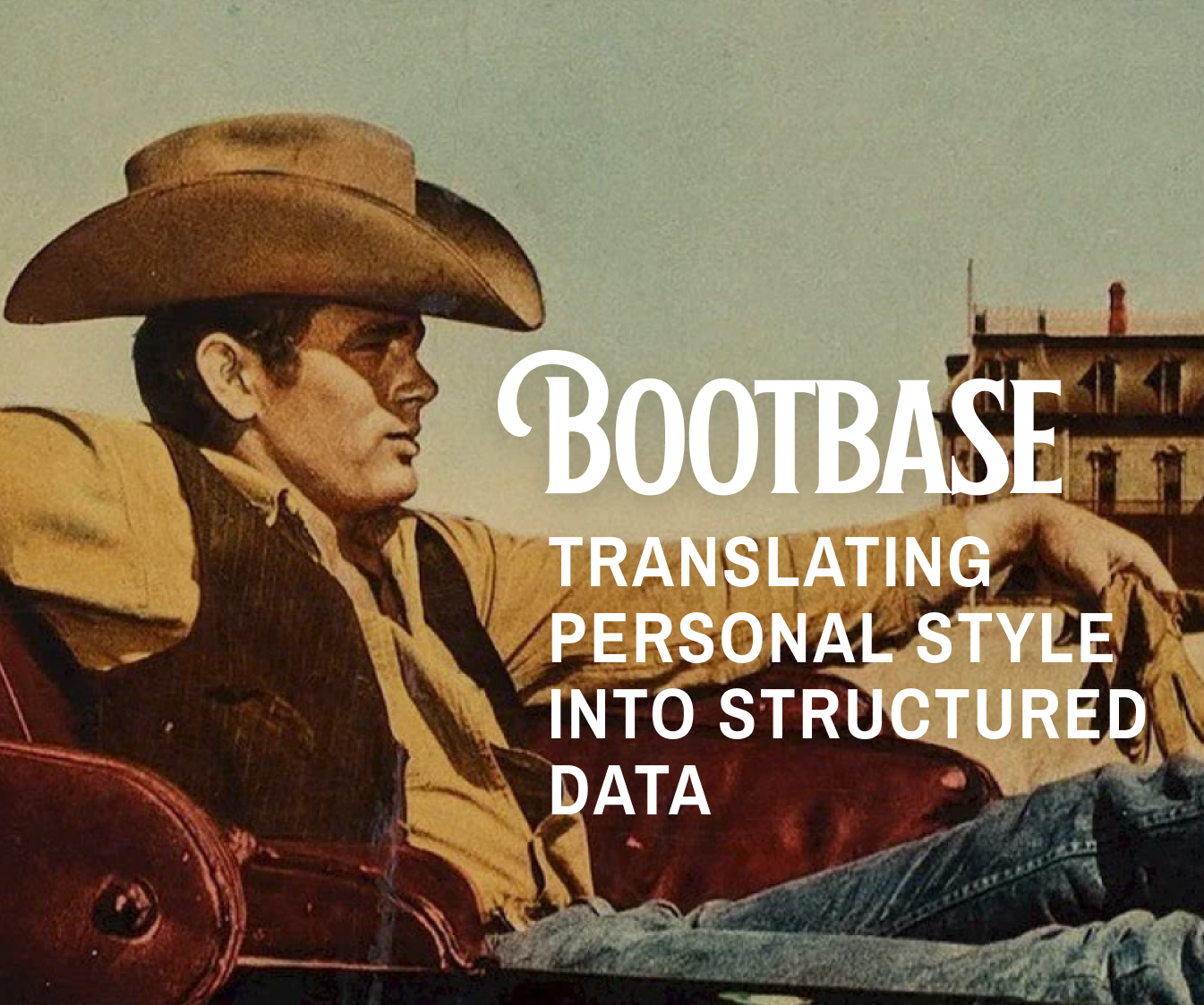


Bootbase is a concept case study
Designed and built a concept platform exploring structured approaches to personal style. Defined the multi-axis style model, developed the Style Finder and scoring logic, and implemented the front-end experience. Used the project to test UX patterns for progressive disclosure, decision support, and system-driven design.
Executive Summary
Bootbase is a concept platform exploring how subjective personal style can be translated into a structured, data-driven system. Focused on cowboy boots and Western fashion, the project examines how users make style decisions in environments shaped by cultural signals, identity, and ambiguity.
Rather than relying solely on traditional product filters, Bootbase introduces a multi-axis style model designed to map individual preferences across dimensions such as Classic ↔ Fashion-Forward, Rugged ↔ Polished, and Everyday ↔ Statement. This approach enables more nuanced user profiles and supports decision-making beyond rigid categories.
The project serves as a UX research and prototyping environment, demonstrating how experience-layer thinking—through progressive disclosure, structured inputs, and interpretable outputs—can reduce decision friction and improve usability in complex, subjective domains.
Bootbase is an ongoing exploration of how structured systems can be applied to human-centered problems, with potential applications in recommendation engines, content systems, and personalized product discovery.
Role & Scope:
UX Designer, Researcher, and Front-End Developer
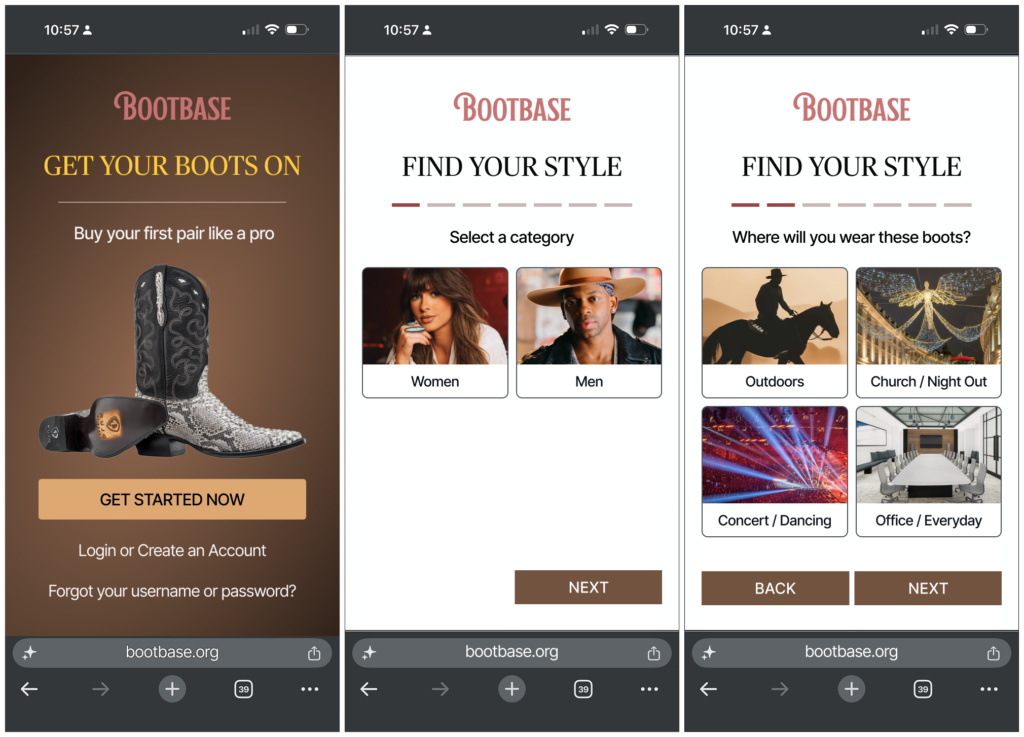
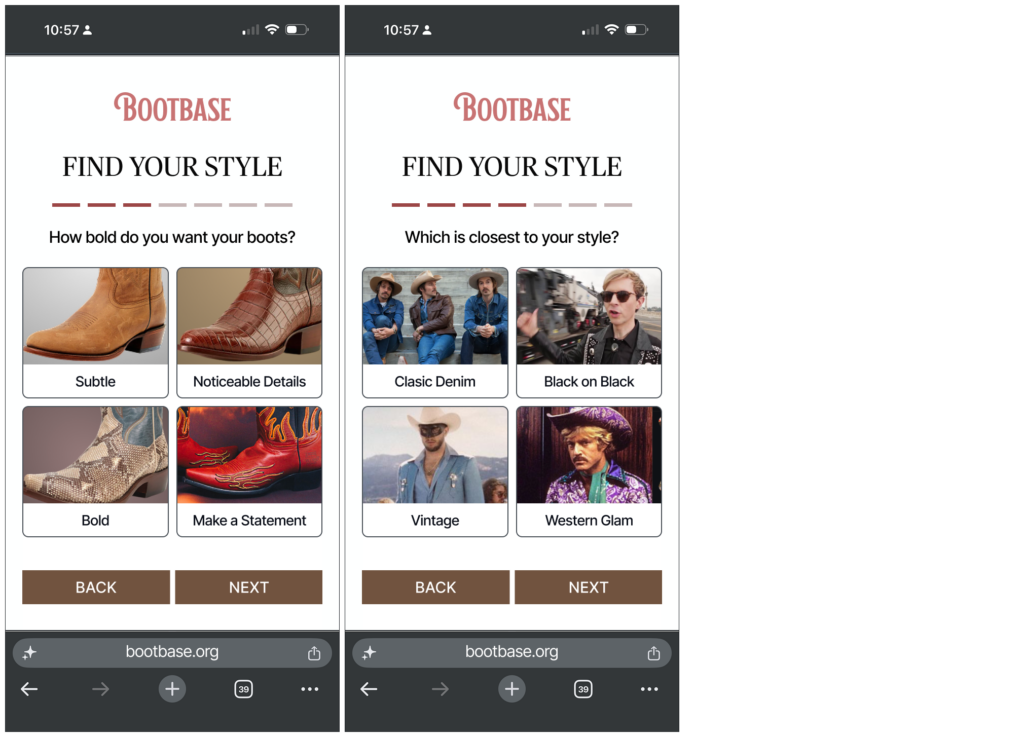
End-to-end design and development of a concept platform exploring how personal style can be translated into a structured system. Responsibilities included defining the style model, designing the Style Finder interaction, developing scoring logic, and implementing the front-end experience using WordPress and Bootstrap. The project also served as a test environment for UX patterns related to progressive disclosure, decision support, and system-driven interfaces.
Key Design Decisions
1. Modeling Style as a Multi-Axis System
Instead of relying on traditional categories (e.g., “classic,” “modern”), style was defined across five continuous axes. This allows for more nuanced user profiles and avoids forcing users into rigid labels that don’t reflect how people actually express identity.
2. Prioritizing System Before Surface
The underlying scoring model and structure were developed before visual refinement. This ensured the experience was driven by logic and interpretability rather than aesthetics, allowing the system to scale and evolve without redesigning the foundation.
3. Incremental Scoring Over Binary Choices
User inputs adjust style positioning through small, weighted shifts rather than fixed outcomes. This creates more realistic profiles and supports subtle variation, reflecting how personal style develops across a spectrum rather than in absolutes.
4. Progressive Disclosure to Reduce Decision Friction
The interface surfaces only the most relevant inputs at each step, avoiding overwhelming users with too many choices at once. This approach reduces cognitive load and supports more confident decision-making in a subjective domain.
5. Designing for Interpretability, Not Just Output
The system is structured so users can understand why they receive a given result. By making the logic legible, the experience builds trust and encourages engagement rather than presenting results as a black box.
6. Allowing for Tension Within the Model
The system supports conflicting traits (e.g., Rugged and Polished) rather than forcing resolution. This reflects real-world identity, where style is often shaped by contrast rather than consistency.
7. Treating the Platform as a Living System
Bootbase was intentionally designed as a flexible framework rather than a fixed product. The structure supports future layers such as recommendation engines, archetype mapping, and content integration without requiring a redesign.
Outcome / What This Demonstrates
Bootbase demonstrates how experience-layer thinking can be applied to complex, ambiguous problem spaces. By translating subjective inputs into a structured system, the project shows how design can reduce decision friction without oversimplifying the user’s identity or intent.
The work highlights an approach to UX that prioritizes systems over screens—focusing on structure, interpretability, and scalability before visual refinement. This same methodology can be applied to enterprise environments, where fragmented data, unclear signals, and cognitive overload often impact decision-making.
While Bootbase operates in a consumer-facing context, the underlying principles—progressive disclosure, decision-layer design, and structured modeling—directly parallel challenges found in legacy systems and ERP platforms.
This project reflects my broader approach to UX: designing systems that make complex decisions clearer, faster, and more reliable.
Design
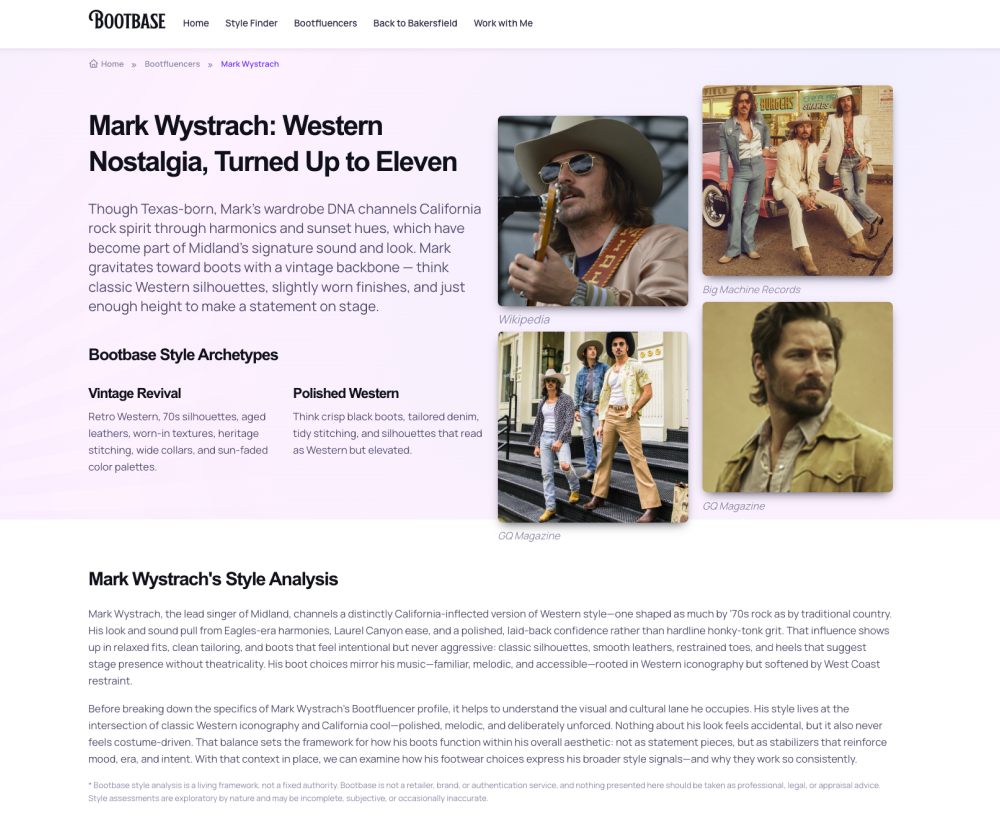
Example Bootfluencer Profile
Mark Wystrach’s profile sits at the intersection of classic Western and polished California cool—combining vintage silhouettes, worn textures, and restrained detailing. His style avoids extremes, using subtle nostalgia and clean tailoring to create a look that feels both familiar and elevated, where boots function as quiet anchors rather than overt statements.
Mark Wystrach — Style Mapping
Classic ↔ Fashion-Forward: 70 / 30
Leans heavily classic—traditional Western silhouettes and timeless pieces—but with subtle styling choices that keep it from feeling dated.
Rugged ↔ Polished: 45 / 55
Sits just on the polished side. Textures and materials nod to ruggedness, but overall presentation is clean, intentional, and refined.
Lowkey ↔ Statement: 60 / 40
Generally restrained. His look doesn’t rely on bold or flashy elements—presence comes from cohesion rather than standout pieces.
Traditional ↔ Fluid: 75 / 25
Strongly rooted in traditional Western menswear. Minimal experimentation with gender-fluid or boundary-pushing elements.
Everyday ↔ Stage: 50 / 50
Balanced. His style transitions seamlessly between offstage wear and performance—elevated, but never theatrical.
How Style Overlap Drives Recommendations
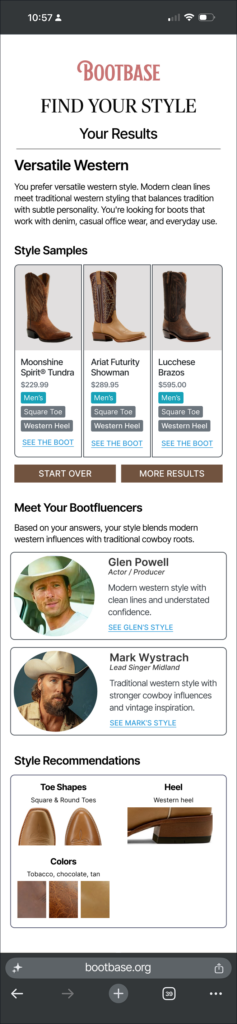
Bootbase generates recommendations by comparing a user’s personal style mapping with Bootfluencer reference profiles. Rather than matching users to a single aesthetic, the system identifies areas of overlap across key style axes.
This shared “style territory” becomes the basis for recommendation. When a user’s profile aligns with a Bootfluencer like Mark Wystrach in areas such as Classic orientation, Polished finish, or balanced Everyday-to-Stage presence, those overlapping traits are translated into specific boot characteristics.
Instead of suggesting exact products, the system recommends directional attributes—such as silhouette, material finish, toe shape, and level of visual emphasis—derived from the strongest points of alignment.
Bootfluencer profiles function as intermediaries between abstract style identity and concrete product guidance, allowing users to navigate subjective decisions with greater clarity and confidence.