Recovery Center Website Redesign
Behavioral Health / Web Design / SEO / WordPress / Information Architecture
A two year digital transformation spanning website design, search visibility recovery, content strategy, and patient acquisition
Across three generations of a behavioral-health website, I restored search visibility after a Google penalty, replaced high-risk SEO practices and low-quality content, and rebuilt the experience around credibility, accessibility, and prospective-patient needs.
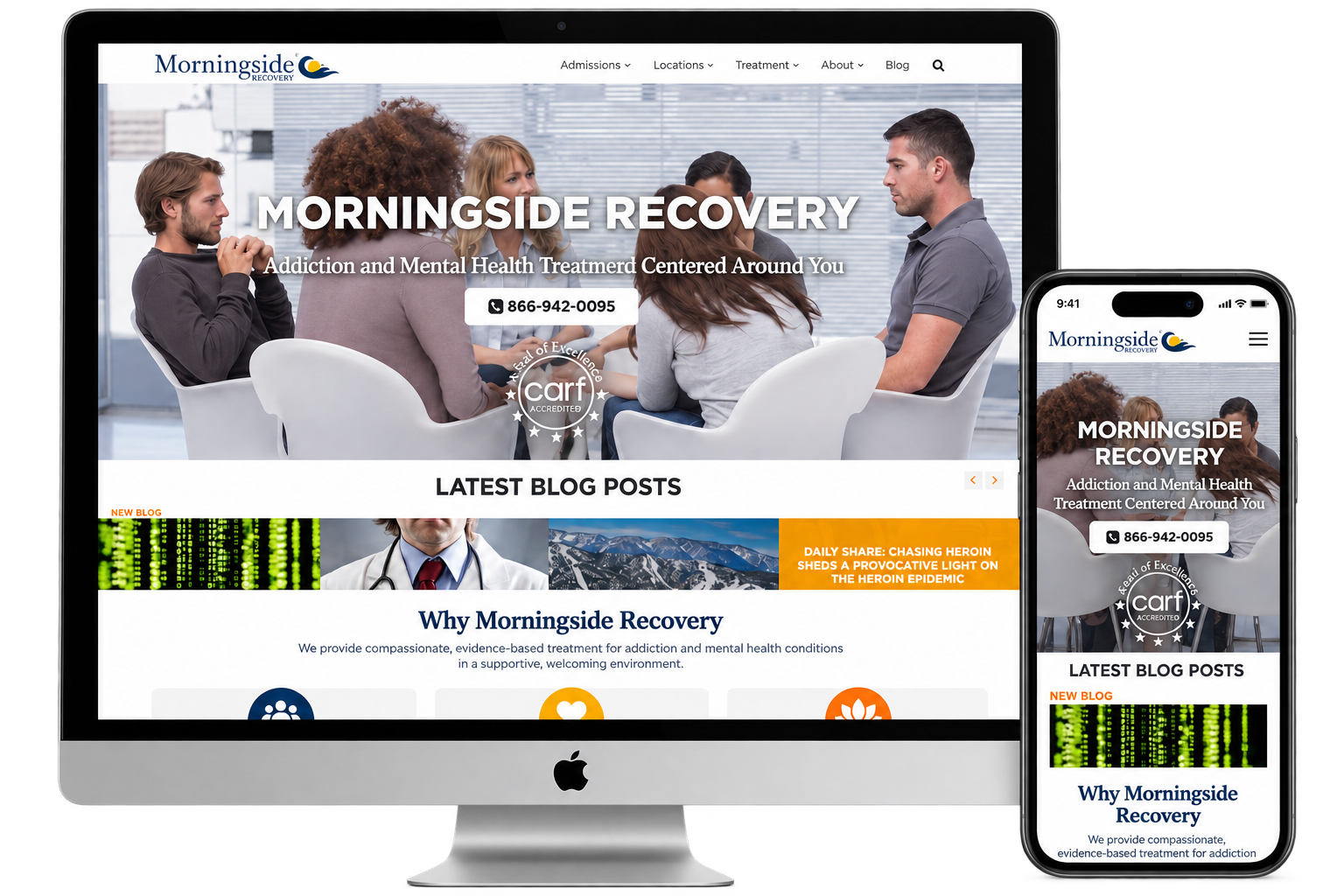
Project Overview
I led a multi-year digital transformation for a behavioral healthcare organization, redesigning and developing multiple generations of its WordPress website while supporting marketing, admissions, and patient-acquisition goals. The work included recovering organic visibility after a Google penalty, replacing harmful SEO practices and low-quality content, and improving the pre-admission experience for prospective patients and their families. I also helped connect the website experience with call tracking, CRM workflows, and internal operations to create a more credible and cohesive path from initial research to treatment.
Challenge
The organization’s digital presence had been weakened by outdated websites, inconsistent content, harmful SEO practices, and a Google penalty that reduced organic visibility. Prospective patients and their families were often searching for help during stressful, time-sensitive situations, yet the online experience did not provide a clear or credible path from initial research to contacting admissions. The challenge was to restore search performance and trust while creating a more cohesive experience across the website, marketing content, call tracking, CRM workflows, and operational teams.
The organization faced a weakened digital presence due to outdated websites, inconsistent content, harmful SEO practices, and a Google penalty. The goal was to restore search performance and trust while creating a cohesive online experience for prospective patients and their families.
My Skills
Applied WordPress development, responsive web design, information architecture, technical SEO, content strategy, CRM and call tracking integration, and creative direction.
WordPress
Designed, developed, and maintained responsive WordPress websites across multiple iterations of the organization’s digital presence.
Pagelines Page Builder
Built and maintained responsive WordPress page layouts using the PageLines visual page-building framework.
Bootstrap
Used Bootstrap to create responsive, mobile-friendly layouts and maintain visual consistency across the website.
HTML/CSS/PHP/Javascript
Used custom HTML, CSS, PHP, and JavaScript to extend WordPress, refine page layouts, and create responsive interactive experiences.
Technical SEO
Identified and corrected technical SEO problems that contributed to a Google penalty, helping restore organic search visibility.
End-to-End SEO
Managed SEO from technical remediation and keyword strategy through content development, on-page optimization, implementation, and performance monitoring.
Content Strategy
Restructured and developed content around prospective patients’ questions, emotional needs, and journey from initial research to contacting admissions.
Information Architecture
Reorganized navigation and content hierarchies so patients and families could find treatment information and take the next step more easily.
Designing a More Credible Path to Care
Morningside’s digital presence extended well beyond its primary treatment website. I supported a portfolio of specialized web properties that included Discovery Houses for sober living, Spectox Laboratories, and a dedicated Bipolar Treatment Center, each serving a distinct audience while connecting people with appropriate services and support. At the same time, Hasinai Ranch—a higher-end recovery center outside Austin, Texas—was in development and required its own emerging brand identity and digital direction.
Across these properties and multiple website iterations, I worked to make complex treatment information easier to understand, establish credibility, and create clearer paths to insurance verification, admissions, and direct support. The examples below show how the broader digital experience evolved across treatment programs, supporting services, content campaigns, and new recovery brands.


Improved Structure and Clearer Paths
I reorganized the homepage around the questions prospective patients and families were most likely to ask: what treatment was available, where care was provided, what made the organization different, and how to get help. Clear navigation, scannable program sections, current educational content, insurance verification, and a direct assessment form created a more understandable path from initial research to contacting admissions.
Better Content and a Stronger Search Foundation
I replaced thin, inconsistent, and search-driven copy with clearer content organized around treatment options, patient questions, and admissions needs. Working with an in-house writer, I strengthened core service pages, expanded useful educational content, and aligned page structure, metadata, internal linking, and keywords with sustainable SEO practices—helping rebuild credibility with both prospective patients and search engines.
Clearer Paths to Admissions
Because visitors arrived with different levels of urgency and readiness, I created several clear ways to begin the admissions process. Prominent phone numbers, insurance verification, treatment and location information, and a direct assessment form allowed prospective patients and families to choose the next step that felt most appropriate—without having to search through the site for help.
Building Trust at a Critical Moment
People researching addiction treatment are often making urgent decisions while experiencing fear, uncertainty, or emotional exhaustion. I strengthened trust by making accreditation, accepted insurance providers, treatment options, facility locations, staff expertise, and inclusive programs more visible. Clear language and direct access to help made the organization feel more credible, transparent, and prepared to support patients and their families.
Distinct Programs for Different Needs
Rather than presenting treatment as a single, standardized experience, I gave greater visibility to the programs and services that addressed different patient needs. Pet-friendly treatment, LGBTQ+ inclusion, outdoor and experiential therapy, alumni support, specialized mental-health care, and multiple facility locations helped prospective patients recognize where they might feel safest, most understood, and best supported.
A Flexible, Scalable Website System
I built Version 3 as a modular WordPress system using PageLines, reusable layouts, and consistent content patterns. This allowed the team to add new treatment programs, locations, articles, campaigns, and supporting services without redesigning the site each time, while maintaining a cohesive experience as the organization’s digital portfolio continued to grow.
Version 4 — From Builder to Digital Team Lead
For Version 4, my role shifted from hands-on website production to digital leadership. I hired and managed two developers, a content writer, an SEO specialist, and a social media specialist, setting priorities and coordinating their work across the website and supporting channels. Although I did not personally design or develop the final site, I led the team responsible for its strategy, content, search visibility, implementation, and ongoing digital presence.
Version 4 — A Modern Platform with a Stronger Sense of Place
For Version 4, we replaced PageLines with a custom WordPress theme built using the Roots Sage framework. Sage introduced a more professional development workflow—including Gulp, Bower, and npm—that made the codebase more structured, maintainable, and scalable. As digital team lead, I directed the strategy and coordinated the developers, content writer, SEO specialist, and social media specialist.
I also hired photographer Ross Laurence to produce original Orange County imagery that gave the site an authentic Southern California identity. Because we marketed heavily to prospective patients in Wisconsin, the coastal environment, climate, and distance from familiar surroundings became meaningful parts of the treatment story rather than simply decorative imagery.

Services Provided
My responsibilities evolved alongside the organization’s digital presence. I began with hands-on troubleshooting, WordPress development, design, and SEO, then expanded into content strategy, user experience, branding, campaign development, and admissions optimization. By the fourth website generation, I had moved into a leadership role—building and directing a multidisciplinary digital team while coordinating the organization’s broader website, search, content, and social media strategy.
- Digital strategy and project leadership
- WordPress design and development
- Website troubleshooting and data recovery
- Information architecture and user experience
- Responsive front-end development
- PageLines and Roots Sage implementation
- Content strategy and editorial direction
- Technical and on-page SEO
- Google penalty remediation
- Admissions and conversion-path optimization
- CRM and call-tracking coordination
- Brand identity and graphic design
- Photography and creative direction
- Paid-content campaign development
- Team recruitment and management
- Cross-channel digital marketing coordination